Regretfully, an unforeseen cost increase with the Enumclaw Fountain Project has forced Spring to the Tap’s board of directors to change plans with the project, moving away from the bronze sculpture design.
Spring to the Tap remains committed to the project's main goal of providing the city a drinking fountain and filling station. A commercially manufactured drinking fountain, still with bottle refilling capacity and pet drinking bowl, will not be as unique, but it will serve the core of the mission to ensure clean, accessible, and sustainable water for all. Additionally, the lesser cost of such a fountain will allow Spring to the Tap to continue to support the community's tap water; for example, by upgrading or repairing existing drinking fountains.
We will provide an update at the next stage of the process. Your support through this effort to date is appreciated.
The beginning of fall marked the end of one of the worst summers in recent memory. Washington set a record (now in two consecutive summers) for the largest and most destructive wildfires in state history. Across the country over 8 million acres burned this summer, a total reached only five other times in the last 55 years. In part, this results from the world's hottest summer ever, shaping up 2015 to be the warmest year ever recorded––by a large margin.
The trend of increased burning and warming stresses water resources. In California a rapidly declining snowpack (the Sierra Nevada Mountains' snowpack hit a 500 year low) along with water shortages and rising temperatures have pushed Chinook salmon to the brink of extinction. Washington's glaciers are at their lowest levels in 4,000 years despite efforts by rain this winter to remediate lingering drought the depleted snowpack could mean less salmon, stalled hydropower, desiccated agriculture, and dried-up drinking water for years into the future.
The problem with plastic pollution is not just its unsightly appearance on our beaches and in our waterways and its potential to kill animals that eat plastic pollution, but also that plastics absorb toxic chemicals and allow them to bioaccumulate in the food chain. A report came out in September that endocrine disrupting chemicals––which can leach from plastics we use everyday––can become even more toxic in the presence of other chemicals.
Many groups are taking common sense approaches to reduce their use of avoidable items like bottled water. The National Parks Service is one agency leading by example, making tap water more accessible in parks across the country. But big corporations like Coca-Cola use exclusive deals with parks to sell over-priced water to tourists, and they do not like these sustainability initiatives. This summer beverage corporations used their influence in Congress to insert a measure into the House spending bill barring the park service from using federal money to support bans. In the final spending bill just passed this December, the only requirement for parks was to issue a report stating how these bans benefit the parks and the public in nineteen national parks across the country.
The importance of a safe, accessible, and sustainable source of water has never been more apparent to some communities. The town of Cascade Locks, Oregon is still in negotiations with Nestle (now for seven years) over a process aimed at transferring rights to Nestle to bottle spring water currently owned by the Oregon Department of Fish and Wildlife used for an endangered salmon hatchery. Locals responded recently by filing a ballot initiative that would give residents a say in whether Nestle could bottle thousands of gallons of water in their town. Meanwhile, groups in California are suing Nestle over its illegal bottling of water on their national forest land.
These efforts highlight the need for a different kind of fight, one to once again value the safety of our water resources. This is a fight against the bigger problem; water schemes deny the right of all people to clean, cheap, and sustainable water. Often Americans dismiss access to water as occurring only in far away places, but even today investment and support for municipal water systems is gravely needed in communities like Flint, Michigan, and within the Navajo Nation.
Somewhere between 15 trillion and 51 trillions pieces of plastic litters the world’s oceans, a new study has found. That’s three to 10 times more plastic than scientists had previously estimated.
To start a hot July and August news update, Spring to the Tap's home state of Washington is currently facing its worst drought in recorded history. The historic-low snowpack is indicative of a drought so bad that even the Queets rain forest in the typically damp Olympic National Park is on fire. The lack of rainfall is severely impacting the Pacific Northwest's salmon runs, with one report stating at least a quarter of a million sockeye salmon returning to the Columbia River are dead or dying due to very warm waters -- a premature-death toll that could rise to 80% of the around 500,000 sockeye returning from sea to spawn. The Columbia River is currently experiencing a 60-yearlow in water level, but on top of that, officials say, the prolonged periods of above-average summer temperatures make the already stressed fish far more susceptible to disease.
Unfortunately, the little water we have left isn't doing so hot either. A crew working for the EPA in Colorado triggered a massive spill of three million gallons of toxic mine wastewater down the Animas River on August 5th. The orange plume containing arsenic, lead, copper, aluminum and cadmium has now reached Utah and New Mexico according to reports. In the Pacific Ocean, the warmer-than-average waters have created ideal conditions for one of the largest toxic algae blooms scientists have ever seen. Stretching from California to Alaska, the "red tide" is up to 40 miles wide and 650 miles deep in places, and is already having dire effects on fisheries and ecosystems.
If that wasn't enough, New Jersey Governor and presidential candidate Chris Christie recently signed a law allowing cities in his state to sell off their municipal watersystems to private companies without public approval. The desire to bypass a public vote makes sense because it would be tough to pass a measure allowing companies to profit from the human right to water as it has led to higher prices and lower quality service for residents across the country. But Christie isn't the only one catering to mega-corporations seeking control of our water. Ever since the waste-reducing act of banning bottled water caught on in National Parks across the country, Coca-Cola has been doing everything it can to fight the measures. Corporate interests recently succeeded, by convincing a member of congress to slip a last-minute amendment into the House spending bill barring the Parks Service from using federal money to support such bans. The National Parks Service responded by claiming it will find money elsewhere to support its sustainability initiatives.
On the west coast, the small town of Cascade Locks, Oregon is still awaiting decision on Oxbow Springs. Nestle is in the seventh year of a process aimed at gaining rights to bottle spring water currently owned by the Oregon Department of Fish and Wildlife used for an endangered salmon hatchery. The multinational company has been making runs at small community springs around the Pacific Northwest for years now, using its massive legal and monetary resources (promising opportunity and subtly smearing opposition) as leverage in economically-struggling cities.
Your top three water-related stories to read for July and August are below. Also be sure to follow those linked above and a visit our rolling total of all news articles now available at springtothetap.org/p/news.html.
August 5th, The Point of No Return: Climate Change Nightmares Are Already Here - Rolling Stone The worst predicted impacts of climate change are starting to happen — and much faster than climate scientists expected. July 28th, Warm water killing half of Columbia River sockeye salmon- Register-Guard More than a quarter million sockeye salmon returning from the ocean to spawn are either dead or dying in the Columbia River and its tributaries due to warming water temperatures. July 8th, We don’t trust drinking fountains anymore, and that’s bad for our health - Washington Post Fountains were once a revered feature of urban life, a celebration of the tremendous technological and political capital it takes to provide clean drinking water to a community. Today, they’re in crisis.
If you see anything we missed be sure to share it with us in the comments, or on Facebook or Twitter!
Bimonthly recaps of all tap water, bottled water, plastic, and other Spring to the Tap related news!
Fracking chemicals detected in Pennsylvania drinking water - New York Times
May 4th, a study found household drinking water in a Pennsylvania town was contaminated with a common fracking chemical likely the result of a faulty drilling well.
May 5th, a researcher on human behavior found that people are more likely to opt for curtailment solutions to try and reduce their water use (taking a shorter shower, for example). They found that the most effective water saving strategies, however, usually involve efficiency solutions that incur a one-time expense, like installing a low-flow toilet.
May 11th, the bottled water industry is being analyzed during a time of drought in California. Although there may be more egregious overuses of water in the state, the industry still faces criticism for their questionable tactics including bottling water from a national forest without a valid permit.
May 14th, the same day Nestle Waters' CEO claims he would like to increase bottling operations, a statement from Nestle claims the company will invest in new technologies to help conserve water at their California plants.
May 15th, Jay Inslee declares a statewide drought emergency, citing snowpack levels at 16% of average, which will impact summer irrigation supplies, as well as the potential for a severely dangerous wildfire season.
Nestle Bottled Water Plant Draws Fight in Drought-Stricken Oregon - Bloomberg Politics
May 26th, negotiations between Nestle and the Oregon Department of Fish and Wildlife and the Oregon Department of Natural Resources began in 2008 and are still ongoing, and generating more opposition. Nestle is still attempting to acquire the rights to Oxbow Springs in Cascade Locks, a town of 1,235 people.
May 27th, the United States EPA and Army Corps of Engineers released new federal rules to better clarify which steams and tributaries are protected under Clean Water Act regulations.
Scientists say plastic pollution in Great Lakes poses problems beyond cluttered beaches - Star Tribune
May 28th, scientists met at the University of Vermont to assess the threat of plastic in the Great Lakes. About 80% of the pollution in the Great Lakes is plastic, some of that debris is too small to see, and most plastic can harbor toxic chemicals.
Our Water-Guzzling Food Factory - New York Times
May 30th, an opinion on the management of water for agriculture, the largest user of water in California.
Fracking not a 'widespread risk' to drinking water: U.S. EPA - Reuters
June 4th, a U.S. EPA report draft five years in the making concludes that fracking is not a widespread risk to drinking water, but notes that water contamination and other health risks do occur as a result of fracking.
A Better Way For California to Water Its Farms - Wired
June 5th, dry-farmed grapes and tomatoes are less expensive to maintain, better protect the soil, and most importantly use much less water than traditionally irrigated farms. Other techniques like drip irrigation, micro emitters, or carefully choosing crops, provide possible alternatives for an increasingly water scarce world.
Our Fate is Tied To Our Ocean - Huffington Post
June 8th, a round-up of the importance of our oceans as a resource, and ways humanity, with overfishing, plastic, and carbon dioxide, are harming our marine lifeblood.
California Cuts Farmer's Share of Scant Water - New York Times
June 12th, with snowpack at a historic low, seniors water rights holders, some with claims dating back to 1903, face water usage cuts in California.
New NASA data show how the world is running out of water - Washington Post
June 16th, underground aquifers supply 35% of worldwide water use, and twenty-one of the world's largest thirty-seven aquifers have been dangerously depleted in the last ten years.
How A Historical Blunder Helped Create the Water Crisis in the West - NPR
June 25th, in 1922 the states of Colorado, Utah, New Mexico, Arizona, Nevada, Wyoming, and California reached an agreement on dividing the waters of the Colorado River, the only problem is that the states were promised more than the water that actually exists.
Bottled water recalled over E. coli concerns - USA Today
June 23rd, Niagra bottling is recalling fourteen brands of bottled water due to possible E. coli contamination at one of their plants.
June 30th, tiny marine organisms that mistake plastic for food allow microplastics to pass up the food chain, along with the chemicals they harbor, to many different species of marine life, and possibly including humans.
Did you see any other interesting stories the last two months? Be sure to share them with us in the comments, or on Facebook or Twitter!
Monthly recaps of all Spring to the Tap related news-- tap water, bottled water, plastic, and more! California Orders 12 Oil-Field Wells Shut to Protect Groundwater - LA Times
March 3rd, California officials order 12 oil-field wells, including some used in hydraulic fracturing, to stop operating due to concern of groundwater contamination.
California is pumping water that fell to Earth 20,000 years ago - Reveal, from The Center for Investigative Reporting
March 9th, "As California farms and cities drill deeper for groundwater in an era of drought and climate change, they no longer are tapping reserves that percolated into the soil over recent centuries. They are pumping water that fell to Earth during a much wetter climatic regime – the ice age."
Should bottled water companies sell national forest water? - CBS MoneyWatch
March 20th, despite major water shortages in California, Nestle has been pumping out groundwater from the San Bernardino National Forest with an invalid permit that expired 27 years ago.
Plastic pellets found in puffin tummies - CBS News
March 27th, Scottish researchers discovered that puffins are ingesting plastic pre-production pellets, adding to the list of species shown to eat toxic plastic.
Activists 'Shut Down' Nestlé Water Bottling Plant in Sacramento - Daily Kos
March 27th, protesters blocked the entrance to a Nestle bottling plant disagreeing with their favorable treatment from the local government and their unsustainable water usage during a time of drought.
April 2nd, a survey found around one thousand tonnes of plastic floating in the Mediterranean.
ODFW agrees to new approach for Nestle bottled water plant in Cascade Locks - The Oregonian
April 10th, the Oregon Department of Fish and Wildlife agreed to give rights to the water flowing out of Oxbow Springs, which is used to supply an endangered salmon hatchery, over to Nestle for bottling water.
Forest Service: Expired Nestle Water Permit A Priority - The Desert Sun
April 11th, an investigation in March discovered that Nestle is bottling water in the San Bernardino National Forest with a permit that expired 27 years ago, now the U.S. Forest Service is looking into the issue.
Nestlé Waters: Bottled water is not contributing to California’s drought - San Bernardino County Sun
April 28th, a Nestle Waters North American official writes that Nestle bottles an amount of water equal to two California golf courses over the course of a year, and that their operations are not contributing to the drought.
Monthly recaps of all Spring to the Tap related news-- tap water, bottled water, plastic, and more!
The Politics of Drinking Water - The Atlantic
A history of tap water shows how the growth and importance of clean tap water in the United States reflects the status of the nation.
The Unlikely Champion of a Water Bottle Ban- The New York Times
A story of how Xanterra Parks and Resorts, which operates concessions for many National Parks, is championing efforts to promote tap water, despite losing revenue from their choice not to sell bottled water.
Water and Classical Civilizations - Crash Course Word History
John Green explains how water's life-giving power has influenced the course of world history.
This spring, the city of San Francisco passed an ordinance to prohibit the sale and distribution of single-use plastic water bottles on public property. This video highlights the San Francisco city leaders and community members who led the way and includes information on the passing and future implementation of the ordinance, and how it can serve as a model to reduce plastic pollution in cities around the world.
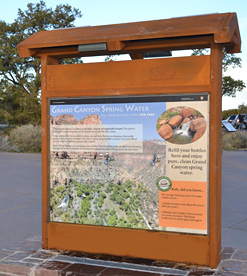
Refilling station from Grand Canyon National Park, photo from nps.gov/grca
Corporate Accountability International is currently running a petition to make our national parks bottled water free. The petition is 3,760 signatures away (1,240 total as of February 27th) from their goal of 5,000 signatures. A few National Parks have already taken the initiative and banned the sale of bottled water, including Grand Canyon National Park, Saguaro National Park, and Zion National Park. It just takes a few seconds to sign the online petition which will "...help bottled water take a hike out of our national parks by phasing out sales as soon as possible. We can promote and protect the environment, and the tap, by making clear that water, like our parks, is not for sale and deserves our long-term investment," you may also consider checking out Corporate Accountability International's Think Outside the Bottlecampaign. UPDATE (March 24) : The petition got a big boost and is now only 448 signatures away from the goal of 5000, click here to sign the petition.
On January 1st, 2013 the town of Concord, Massachusetts became the first city (in the U.S.) to ban bottled water. The ban prohibits the sale of unflavored drinking water made from PET or PETE (polyethylene terephthalate) under the size of 1 liter. The Bottled Water Association (an association of bottled water companies) is reportedly taking signatures to try and combat the ban. Here is an article from Huffington Post and below is a clip from WCVB, a Boston-based news station. January 1st, 2013 also marks the date that the University of Vermont bans the sale of bottled water on campus. Universities seem to be setting the trend with bottle bans, at this point Concord is the only city to ban bottled water while multiple universities across the country have banned the bottle (includes Evergreen State College, and Seattle University).
Forests in north Japan are being purchased by foreigners for as low as 60¢ a square meter, and the land purchased includes the groundwater beneath it. According to the article from Bloomberg News, Japan ranks 10th in the world in water resources, and has less regulation on foreigners purchasing land. The majority of the land purchases come from China-based companies and investors, some of whom plan to tap into the groundwater and export bottled water back to China. The article from Bloomberg Bussinessweek can be found here.
Concord, Massachusetts will ban bottled water (containers less than 1 liter) on January 1st. The International Bottled Water Association, which is run by bottled water companies, is fighting back. They are launching a petition for a public vote in March. Town Clerk Anita Tekle weighed in on the situation:
"'...outsiders hired by large corporations were trying to interfere with our local decisions...'"
You can read more about the bottled water battle that is ensuing in Concord, article from Wicked Local Concord right here.
Here is your summary for news about bottled and tap water around the world. Articles date from October 14th - 16th. Guelph, Canada The city of Guelph was co-sponsoring a Water Conservation Documentary Night, three films designed to promote water conservation, when the city received a letter from Nestle Waters Canada. Nestle was concerned with the screening of Tapped, a documentary that analyses the aspects and impacts of the bottled water industry. I first found out about this on October 6th, and there has since been a development.
City stops screening of "Tapped" after Nestle Canada objects ow.ly/egxPw
— Spring to the Tap (@SpringtotheTap) October 6, 2012
Above: @Spring to the Tap's tweet on October 6th, includes link to other article.
In the end Nestle Canada pressured the city into canceling the screening at the Water Conservation Documentary Night (here the mayor defends her decision), but this Monday (October 15th) Tapped was screened at the University of Guelph campus. The cancellation created more interest in the subsequent screening, sparking more interest in a city where water resources are especially scarce because of its reliance on groundwater.
Chicago Faucet Shoppe Incorporated sued (on behalf of consumers) Nestle Waters North America claiming that the water in the 5 gallon containers is untruthfully labeled. They state that the pristine images of springs wrongfully depict water that is, in fact, bottled tap water.
The District of Columbia Water and Sewer Authority recently took a taste test of over 800 people and more than half preferred the taste of tap water or couldn't tell the difference. Also reported: half of the people surveyed said they drink mostly bottled water.